By September 1944, the Third Army had liberated most of Brittany, participated in the encirclement of the German Seventh Army in the Argentan-Falaise area, reached the Seine River, and by crossing the Marne and Aisne Rivers, hastened the retreat of German forces before it and threatened to close off the escape route of German Army Group G from southern and southwestern.
On 29 August 1944, General Patton announced the next mission for Third Army: to seize and secure bridgeheads across the Meuse River and prepare for a further advance toward and across the Rhine River into the heart of Germany. By this time, a serious shortage of fuel, increasingly bad weather, and difficult terrain, rather than German resistance, were the greatest obstacles it faced.
Note: All maps in this posting are from Cole, Hugh M.; The US Army in World War II: The European Theater of Operations — The Lorraine Campaign. Washington, DC: US Army Center of Military History; 1950.

Next Phase of the Advance
On 4 September, General Bradley, transferred the VIII Corps (then fighting in Brittany, a long distance from the rest of the Third Army) to the new US Ninth Army. This army was to be given a new zone of operation between the Third Army and the US Seventh Army, which had landed in the south of France and then advanced north toward Germany.
This left Third Army with the XX and XII Corps, as well as the small XV Corps consisting of single infantry and armored divisions. These changes took effect at 1500 on 5 September. During the Lorraine Campaign, the XV Corps would several times be transferred back and forth from Third to the US Seventh Army for operational and logistical reasons.
The SHAEF master plan at this time called for the primary attack to be made in the north by the British Second and US First Armies toward the Ruhr industrial area on the Rhine River, inside Germany. Simultaneously, Patton’s Third Army was to make a supporting attack in the south toward the smaller Saar industrial area in that part of Germany west of the Rhine. Bradley and Patton pressed Eisenhower into agreeing that Third Army would make the latter effort. Patton wanted to attack toward the Metz-Nancy-Épinal line with XX and XII Corps abreast in the north and center of the Third Army zone and XV Corps echeloned to the left right rear to protect the Army’s flank until the Ninth Army entered the line.
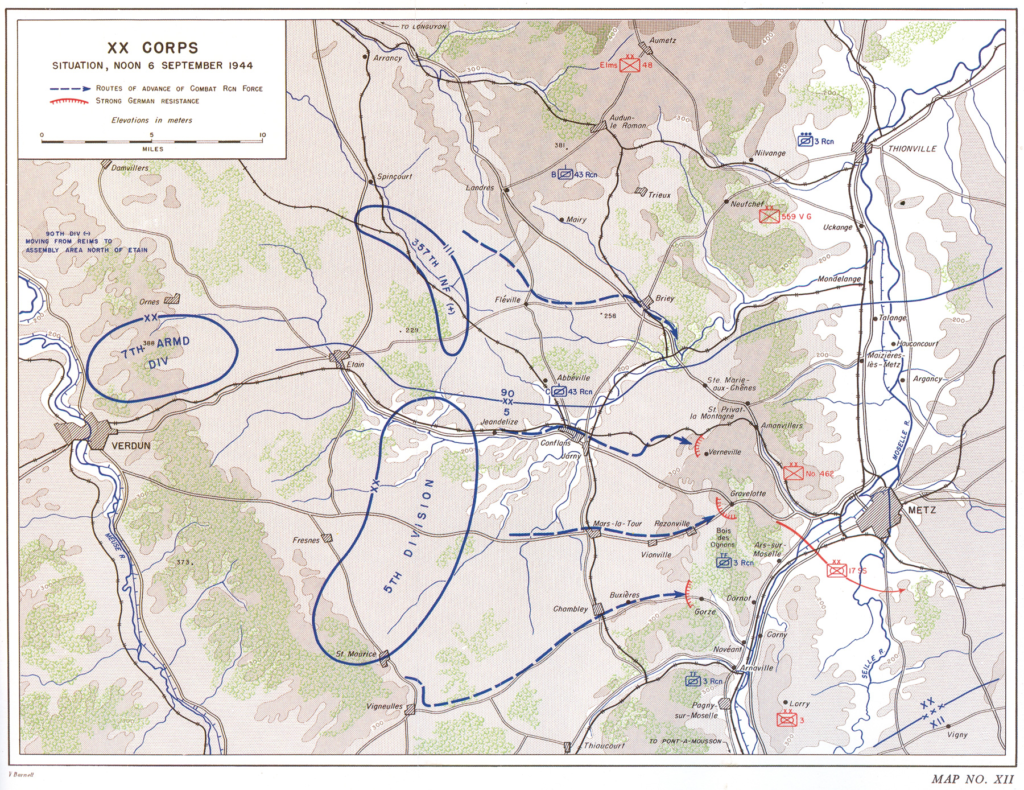
The mission of Major General Manton S. Eddy’s XX Corps (initially the 4th and 6th Armored Divisions, 35th and 80th Infantry Divisions and 106th Cavalry Reconnaissance Group) was to quickly seize the heavily fortified city of Metz on the Moselle River, then advance to Mainz, Germany (more than 124 miles/200 kilometers distant), where it was to secure a bridgehead across the Rhine. On the right (south) of the XX Corps zone, Major General Walton Walker’s XII Corps (initially, 7th Armored Division, 5th and 90th Infantry Divisions, and 2nd Cavalry Reconnaissance Group) was to seize the French city of Nancy, secure the army’s southern flank, and be prepared to advance to and seize a crossing of the Rhine at Mannheim, Germany — a distance of over 155 miles/250 kilometer). Meanwhile, Major General Wade Haislip’s XV Corps (initially, French 2nd Armored and US 79th Infantry Divisions), echeloned to the southwest on Third Army’s right, was to make contact with the US Seventh Army in the Épinal area and then follow Third Army into Germany.
Patton was always thinking about the next campaign as well as the current one and how those two operations fit together. In Lorraine, he clearly was thinking in terms of a mobile, deep battle against an already defeated foe with objectives as far as Frankfurt, Germany, 186 miles/300 kilometers distant. In fact, he and his staff had been planning such a course of action while they were still in England.
Although aware of the dire and still worsening logistical situation regarding fuel, Patton nonetheless was determined to carry out this deep attack. He seemed to believe that, as long as Third Army was advancing, SHAEF would support, sustain, and reinforce his offensive. For someone with such an extensive knowledge of military history and the personal experience of having traveled over much of his future battleground, Patton seemed little troubled by the extensive defenses of heavily fortified Metz, the possible German use of the French Maginot Line defenses, and a determined German stand along the Westwall on the border. Nor did worsening ground and weather conditions seem to trouble him. In effect, Patton was not acting as a loyal player on the SHAEF team. However, this did not distinguish him from how virtually all Allied army group and army commanders were thinking: all wanted to lead the main attack into Germany and none was eager to play second fiddle.
A case can be made that Patton’s operational plan was driven more by geography than SHAEF’s priority on the destruction of the German armed forces. This most likely was because his unexpectedly rapid advance across France to the Meuse River had at no point encountered organized resistance. He saw the German army as no obstacle to advancing deep into Germany, but sensed that it could be a fleeting opportunity. Given his depth of knowledge of military history, he somehow ignored the historical resiliency of the German army.
Patton was no doubt aware that, like the entire US Army, Third Army was too small for the task at hand. Specifically, Third Army could never carry out a broad front advance (the front from Metz to Épinal was 83 miles/134 kilometers long) and fight a deep battle. With a force of just nine divisions, he was planning an attack with an average divisional zone width of over 9 miles/14 kilometers. Even if both his cavalry groups screened sections of the army zone, it still would be difficult to concentrate for a attack in column of units to sustain momentum as fresh units moved through those whose attack had culminated. Clearly, Patton was still thinking of the coming battle as the continued pursuit of a defeated foe. As we will see, this defeated foe was not only reinforcing his front before the Third Army, but was also planning a major counteroffensive to halt Patton’s advance.
It would be some time before Patton accepted that undertaking a deep battle across a wide front was not possible given an ever-worsening logistical situation, the difficult nature of the battlefield, and a recovering enemy.
Crossing the Moselle By 1 September, XX Corps had established a bridgehead across the Meuse at Verdun and XII Corps had another in its zone to the south. Four days later, the Allied supply situation had improved to the point that Third Army was permitted to resume its advance toward the Moselle River. The first unexpected development for Third Army was that the Germans made a strong stand in front of the Moselle rather than along its eastern bank. On 8 September, the clumsy counterattack of an inexperienced German panzer brigade against the 90th Infantry Division in the left of the Third Army zone was soundly defeated. Smaller engagements occurred as other American units moved toward the Moselle. But the clear message was that the Germans were preparing to fight for this line rather than continuing to withdraw toward the Westwall.
From 5 to 11 September, the Third Army made multiple attempts to cross the Moselle. On 5 September, the 80th Infantry Division (XII Corps) sent a battalion from its 317th Infantry straight off the march and without proper reconnaissance and artillery preparation across the river at Pont-á-Mousson. It encountered elements of 3. Panzer Grenadier Division, newly arrived from the Italian front, on dominating ground, who forced the attackers to withdraw.
Meanwhile, to the north in the zone of the XX Corps, Combat Command (CC) B of the 7th Armored Division, not only failed to achieve a crossing at Dornot, but also had to withdraw from the river after being shelled by the well-protected guns of Fort Driant, also on the west bank. When a regiment of the 5th Infantry Division attacked sections of the Metz defenses also west of the river, it was repulsed with heavy losses. By now Third Army was also running short of large caliber artillery ammunition which, so far, had proven ineffective against the enemy’s forts and other fortification.
Stymied by this unexpected resistance, further attempts at forcing a crossing were halted until 10 September. On that day, a regiment of the 35th Infantry Division (XII Corps) seized a bridgehead across the Moselle at Toul, west of Nancy. Also on this day, the 5th Infantry Division (XX Corps) seized a firm bridgehead at Arnaville a few miles south of Dornot, from elements of 17. SS Panzer Grenadier Division. However, German-held Forts Sommy and Blaise on high ground prevented any further movement. Nonetheless, this bridgehead was held in the face of strong coordinated attacks by elements of 17. SS and 15. and 3. Panzer Grenadier Divisions. The presence of three experienced panzer grenadier divisions before the Third Army, even if all of their elements had not yet arrived, was indicative of the priority that the German high command was beginning to attach to the Third Army’s front.

General Bradley informed Patton on 12 September that, unless Third Army could get across the Moselle in strength by the evening of 14 September, he would have to halt his offensive operations. Patton concluded that the only way to avoid this was to seize additional bridgeheads closer to Nancy near the confluence of the Meurthe and Moselle rivers, which was not a fortified area. This was accomplished by XII Corps on 11 September, by the 80th Infantry Division at Dieulouard, the 35th Infantry Division at Dombasle (south of Nancy), and CCB/4th Armored Division at Bayon farther to the south.
Thus, well before Bradley’s deadline, both XX and XII Corps had strong forces established across the Moselle, even though the two bridgeheads remained separated by the German 553. Volks Grenadier Division at Nancy and 3. Panzer Grenadier Division maintained heavy pressure on the Dieulouard bridgehead in the north.
The German Reaction By early September, Hitler was thinking about undertaking an offensive to restore his collapsing Western Front. His focus soon settled on the US Third Army because, among the Allied armies, it had made the most impressive advances, threatened to cut off the retreat of Army Group G from the western and southern coasts of France, was most likely to be the first Allied army to enter Germany, and posed a direct threat to the Saar industrial region. The plan eventually implemented, informally named the Vosges Panzer Offensive, called for the massing of mobile formations including panzer and panzer grenadier divisions, as well as half-a-dozen new (but poorly designed and trained) panzer brigades, under the control of 5. Panzer Armee west of the Moselle. The German offensive was scheduled to commence on 12 September; however, by that date; however, by that date, the assembly area for the main attacking force, west of the Moselle in the the area was in hands of XII and XV Corps. In addition, as we have seen, many of the planned divisions and one panzer brigade were already directly engaged against the multiple Moselle bridgeheads. The French 2nd Armored Division destroyed another panzer brigade at Dompaire on 13 September. The result of these clashes was that no single large-scale German offensive would be ever launched. In fact, the subsequent series of German attacks seemed so uncoordinated that the Americans never fully appreciated that these operations were meant to be a strong counteroffensive.
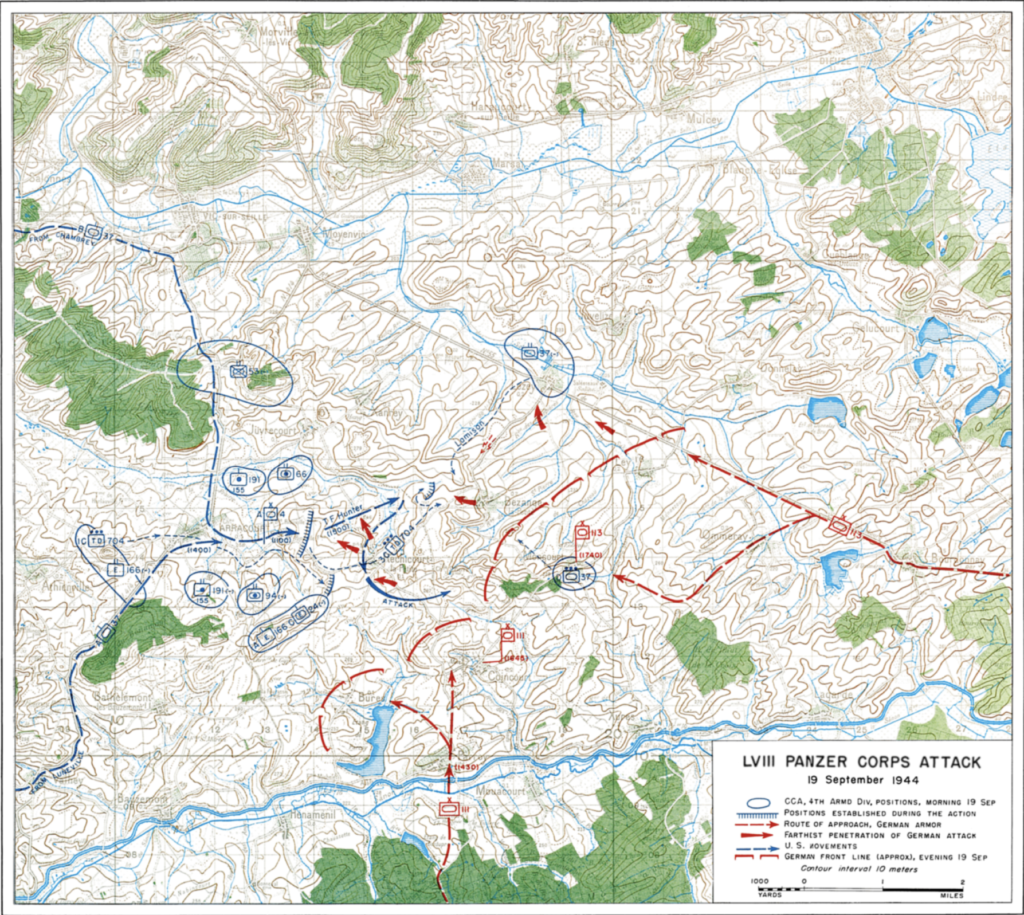
The Battle of Arracourt On the morning of 13 September, in the XII Corps’ Dieulouard bridgehead, even as the Germans continued to press hard against the defending 80th Infantry Division, CCA/4th Armored Division moved across the Moselle, routed an ongoing German attack, and drove 45 miles/72 kilometers deep into the enemy rear toward the important crossroads at Château-Salins, overran the German headquarters responsible for the defense of Nancy to the south, and eventually took up a blocking position near the village of Arracourt. Meanwhile, CCB/4th Armored Division was moved toward CCA’s position to isolate enemy forces in the Nancy area.
From 19 to 30 September, on the relatively open, rolling ground of the Arracourt area, CCA and CCB fought a masterful mobile defensive action initially against three separate panzer brigades which, on 22 September were absorbed into 11. and 21. Panzer and 15. Panzer Grenadier Divisions. By the end of the month, the Germans had lost about 80% of the tanks and assault guns that had been committed to Lorraine. Meanwhile, the 35th Infantry Division endured a heavy counterattack by 559. Volks Grenadier Division in the Grémecey Forest. However, these battles prevented Patton from launching his planned offensive by XII Corps toward Sarreguemines and the German Westwall.

Fortifications Stop XX Corps in the North In the left wing of Third Army, the XX Corps had accomplished less. Although it retained its bridgehead at Arnaville, the corps’ three divisions (5th and 90th Infantry and 7th Armored Divisions) held a 40-mile/64-kilometer front on both sides of the Moselle and had been unable to break through the extensive fortifications defending Metz. These strong works, held by approximately 14,000 men, dated from the 19th century to modern times and included subterranean artillery forts with steel and concrete turrets and casemates. Compounding General Walker’s task was the absence of any intelligence on these fortifications. Despite the use of airpower and heavy artillery, the limited attacks made against these fortified works were unsuccessful and the inadequately trained and equipped infantry experienced heavy casualties. In particular, Fort
Driant on the west bank of the Moselle would remain operational until 8 November, several weeks after the fall of Metz.
The Allied logistical situation continued to worsen throughout the month of September and priority was given to Operation Market-Garden, the ill-conceived airborne and land offensive by the Allied First Airborne and British Second Armies to seize the distant bridge across the Rhine at Arnhem. These resources would have been better applied to opening the German-held Scheldt Estuary waterway to recently liberated Antwerp and its intact port facilities. Only after the failure of Operation Market-Garden was the Allied priority shifted to opening Antwerp. In order to do this, the US 12th Army Group was ordered to remain in place during October. Third Army largely remained in place through 8 November. Fortunately, during October, the French railway network was improved to the extent that trains could again reach Nancy. During this period, much needed repair and replacement of equipment was carried out. Units finally could be pulled off the front for rest, refitting, and the integration of replacements.
On 27 September, the XV Corps was transferred by SHAEF to the Seventh Army, which meant the loss of the French 2nd Armored Division, and the American 79th Infantry Division. Also during this lull, XX Corps lost the 7th Armored Division but gained the 10th Armored and 95th Infantry Divisions. The XII Corps gained the 26th Infantry Division. This meant Third Army still contained a well-balanced force of three armored and six infantry divisions. Also on the positive side, information on the Metz fortifications finally was provided by the French. Additionally, the Germans withdrew some of their best units from Lorraine although it was not realized at the time that this was in preparation for the German Ardennes offensive being readied for December.

Return to the Offensive The plans SHAEF had for a renewed 12th Army Group offensive kept Third Army in a secondary, supporting role, with the intermediate objective of a Rhine crossing between Mainz and Worms and the final objective of Frankfurt-am-Main. Rather than Eisenhower’s plan, General Bradley was considering a wider encirclement of the Ruhr with his First Army in order to avoid the difficult terrain of the Eifel, the German extension of the Belgian Ardennes. Bradley also envisioned the establishment of a Rhine bridgehead near Cologne in the First Army zone. However, Bradley also intended Third Army to undertake a more modest operation to cross the Saar River 30 miles/48 kilometers distant, and to halt there.
On 19 October, Patton unsuccessfully pressed Eisenhower and Bradley to be allowed to advance all the way to the Rhine between Worms and Mainz. Two days later, Patton received orders to resume his offensive on or about 10 November with the objective being the Rhine. Although Third Army outnumbered the opposing Germans by nearly three-to-one in manpower, this advantage was largely offset by miserable weather. Lorraine received twice its normal rainfall in November for a total of seven inches and the worst floods in 35 years that washed away the Moselle bridges. The relatively small Seille River expanded in flooded from 66 to 160 feet. Over 130 bridges were built by Third Army engineers during November.
When XII Corps attacked in the center of the army zone on 8 November without air support, but with the most powerful artillery support in the history of Third Army, it achieved surprise. General Eddy wanted to delay the attack until better weather but was overruled by Patton. Initially attacking with three infantry divisions abreast, General Eddy had to decide when to commit the two armored divisions of his corps reserve. He probably had no real good choice given the weather and ground conditions, but when he attached the combat commands to the infantry divisions, he lost his means for a rapid exploitation. Not surprisingly, 11. Panzer Division was able to severely limit the corps’ rate of advance with a relatively thin screen and local counterattacks. The French city of Sarre-Union was liberated on 4 December after hard fighting; however, the XII Corps attack fell far short of the Westwall.

The Fall of Metz General Walker’s XX Corps attacked in the Metz sector on 9 November and achieved surprise by doing without the usual artillery preparation, aided by the deceptive crossing by a battalion of the 95th Infantry Division at Uckange south of the main Thionville crossing site, and the secret move of the 90th Infantry and 10th Armored Divisions to assembly areas north of Thionville. Here the Moselle had flooded its banks,which flooded the extensive minefields emplaced by the Germans. The 90th Infantry Division had to cross an exceptionally wide and wild river to secure a bridgehead. However, it would be five days before bridges could be emplaced to support the 90th and 95th Infantry and 10th Armored Divisions. When a second flood worse than the first struck, the bridges largely survived, but the approaches to them were inundated. Artillery fire from the west side of the river and limited resupply by amphibious vehicles sustained the bridgehead and held it against repeated strong counterattacks.

With the 90th Infantry Division established on the east bank north of Metz, the 95th Infantry Division advancing from the west and expanding its Uckange bridgehead, and the 5th Infantry Division advancing from Arnaville, XX Corps was closing in on the city. These divisions employed different tactics including the avoidance of frontal assaults, the isolation and systematic reduction of fortifications and strongpoints, and the interdiction by artillery fire of escape routes east from the city. The first American troops entered Metz on 17 November and two days later the 90th and 5th Infantry Divisions linked up east of the city, isolating it from reinforcement and relief. Although several forts held out until mid-December, the main German force inside Metz surrendered on 21 November. General Walker’s corps was the first army to take Metz by storm since 451 A.D.
To the Westwall/Operation Madison Unlike the underground and aboveground fortifications of the Maginot Line and Metz, the Westwall was a belt of tank obstacles, barbed wire, bunkers, and fortified buildings. Although the Germans — and Patton — considered this fortified line to be shallow in depth, outdated, and in poor condition, it nonetheless, proved to be formidable.
On the north of the Third Army, when the 10th Armored Division (XX Corps) crossed the Moselle on 14 November, it was tasked with exploiting east and north to the Saar River, which marked the border with Germany and the fortified line of the Westwall. Although this division gained ground against a determined defense by 21. Panzer Division, the XX Corps’ northern advance was brought to a halt quickly by an east-west extension of the Westwall, called the Orscholz Switch Line located in the triangle between the Saar and Moselle Rivers. This fortification section was one of the strongest Westwall sectors and the resistance along the switch line confirmed that the defenses were strong and held in force. Meanwhile, both the 90th and 95th Infantry Divisions pushed east toward the Saar and, despite heavy resistance, the latter reached the Saarlautern on the Saar by early December. On 3 December, an intact bridge was seized and a bridgehead established over the river. To the northwest, the 90th Infantry Division established another bridgehead near Patchen and fought its way into Dillingen. Although fierce counterattacks were defeated, no further advance was possible.

The left wing of the XII Corps had to fight its way through part of the prewar French Maginot Line. A concentrated attack by the 6th Armoured Division from Morhange toward Rémering-le-Puttelange inside that defensive line was met by elements of 11. Panzer and 17. SS Panzer Grenadier Divisions. Another tough battle at Saint-Jean-Rohrbach required the combined effort of the armored division and 35th Infantry Division. By the end of November, after three weeks of fighting, these two divisions had gained only 27 miles/44 kilometers, but were exhausted by the combat and mud.
The right wing of the XII Corps advanced east toward the Saar with the 4th Armored and 26th Infantry Divisions working together in the right (south) wing of the corps. However, the
Culmination of Third Army’s Offensive
Having suffered exceptionally heavy infantry casualties and possessing only a toehold on the Westwall, Patton decided to rest and regroup his tried command, provide additional training on how to deal with fortifications (something which should have commenced much earlier in the campaign), and integrate new units including the III Corps headquarters and the 87th Infantry Division. Patton planned to resume his offensive on 19 December. Preparations were well under way when the Germans launched their surprise offensive in the Ardennes in the First Army sector to the north. Patton and most of the Third Army would soon find itself attacking in a very different direction in what would be its most significant campaign of the war.
Coming up next: A miniature wargame scenario based on the assault crossing of the Moselle at Arnaville.
Below: At the end of an exhausting, disappointing campaign.
