In the early days of this blog, I posted a series of articles using the Normandy campaign as a case study on how to use reading, map study, miniature wargaming, and battlefield visits to study military operations in the European Theater of Operations.
One of the lesser known and understood campaigns in the ETO was that which took place in Lorraine from 1 September to 18 December 1944 in the Lorraine, France. The US Third Army operations in Lorraine are considered to be a “campaign” in the general sense of the term — a series of related major operations aimed at achieving strategic and operational objectives within a given time and space. It is not one of the six official campaigns established by the US Army for which there is a campaign ribbon. Those who participated in Lorraine campaign were credited with service in the Northern France Campaign (25 July to 14 September 1944) and Rhineland Campaign (15 September 1944 to 21 March 1945).
However, the Lorraine Campaign is the subject of one of the nine volumes of in the United States Army in World War II: The European Theater of Operations; in fact, the very first one published in the ETO series I first read this volume decades ago and had the good fortune to visit large parts of the battlefield in 2012. About 25 years ago at a military book fair in Virginia’s Shenandoah valley I purchased an original copy of this volume. Taped onto the inside of the back cover was an envelope containing a letter dated 7 August 1950 with a Fact Sheet signed by Major General Orlando Ward, then the Chief of Military History.
I’ve recopied that letter here in its entirety as it provides a good introduction to both the Army history series and the Lorraine Campaign.
“Fact Sheet on the Lorraine Campaign Office of the Chief of Military History
(formerly Historical Division)
Department of the Army
Washington 25, D.C.
Publication Date: September 1st 1950
“The Lorraine Campaign, by Dr. Hugh M. Cole, Office of the Chief of Military History, Department of the Army, 657 pp. Illustrated with 67 photographs and 51 maps. Contains bibliographical note, glossary of terms, and complete index. ($10.00)
“Based on official American and German records, The Lorraine Campaign is the story of operations of General George S. Patton’s Third Army in the fall of 1944 agains the German forces defending the territory between the Moselle River and the Siegfried Line. From the seemingly inexhaustible aspects of the campaign narrated in this volume, no one can fail to see what the soldier’s war was like.
“The narrative begins with the situation on September 1st 1944, when the Third U.S. Army has just completed one of the most successful operations in modern military history. Flushed with the successes rolled up during the pursuit, the armored and infantry divisions of General Patton’s army entered upon operations in Lorraine with an extraordinary spirit of optimism.
“This optimism began to vanish, however, during the first few days of the campaign when a gasoline drought struck and left Patton’s mobile columns paralyzed.
“Fortunately, during this paralysis, the enemy was in no position to counterattack; unfortunately, however, this brief lull in operations gave the German forces an opportunity to recuperate. By the time the Third Army was able to resume operations, it encountered a revitalized German force under orders from Hitler to “stand and hold.”
“The operations that followed became characteristic of the fighting in the three and a half month campaign in Lorraine and, in contrast to the pursuit pace of earlier operations, followed the “punch and probe” technique.
“Villages and fortresses in the path of the advance had to be assaulted with frontal and bludgeoning tactics that slowed movement down to an “infantry pace.” Snow, rain, cold, fog, overcast, and mud conspired to hamper the American advance, which sometimes seemed unbearably slow to those who took part. Directly in the path of the Third Army also lay the redoubtable fortress of Metz, the Maginot Line, and the Siegfried Line, and an enemy whose tenacity increased with each American advance on German soil.
“By the time the campaign ended on December 18th, the Third Army had wrested from the enemy 5,000 square miles of territory and denied the Germans the use of the Saar industrial region. Although the campaign lacked the brilliant successes of earlier Third Army operations, it gained a new reputation for Patton’s Army. Its ability to fight a foot-slogging battle, punch its way across heavily defended river lines, and to fight pitched tank battles was to stand Third Army in good stead when it intervened in the Ardennes.
“Major roles during the campaign were played by the 4th, 6th, 7th, 10th, and 12th Armored Divisions and the 5th, 26th, 35th, 79th, 80th, 87th, 90th and 95th Infantry Divisions.
“For those who believe that “history is something that never happened, written by someone who was not there,” Dr. Cole’s book will be refreshing. The author is a veteran of the campaign having served with Third Army as official historian. Dr. Cole brought to his assignment several years of teaching military history at the University of Chicago plus graduation from the Army’s Command and General Staff College. Long a student of military history, he has enriched his narrative with historical parallels whenever appropriate and with maps that will satisfy the most discriminating map readers.
“The Lorraine Campaign launches a nine-volume history on the American armies in the European Theater of Operations, his part of a comprehensive 90-odd volume history, THE U.S. ARMY IN WORLD WAR II, being prepared by civilian historians of the Office of the Chief of Military History, Department of the Army. Earlier combat volumes covered Guadalcanal and Okinawa.”
A four-page addendum to the Fact Sheet added quotations from the book that “were extracted to assist the reviewer.” These spanned the strategic situation, the Third Army mission, Hitler’s intervention in the battle, tactics, incidents and episodes, air cooperation, German estimate of performance, and the campaign’s conclusions and results.
Why the Lorraine Campaign
This campaign involved a wide a range of types of operations conducted under difficult strategic, logistical, terrain, and ground conditions. Numerous opposed crossings of the wide Moselle river took place. Patton wanted to fight a mobile deep battle with his sight on Frankfurt, far beyond the Rhine. The German reaction to the Third Army’s offensive — including the largest counteroffensive mounted since Normandy — combined with extensive fortifications around Metz, along the Maginot Line, and at the West Wall derailed Patton’s plan and considerably slowed the Third Army advance, which culminated as the Saar River, far short of the Rhine, was reached in mid-December.
Military historians and analysts have written extensively about the campaign from the strategic, operational, and tactical perspectives. Patton’s generalship and his application of the operational art is the topic of several excellent analyses, including published studies from the US Army Combat Studies Institute and students at the US Army Command and General Staff College. So there is much information available in books and online to guide to aid gamers, travelers, and students of history..
Dr. Cole’s volume covering the campaign is also the most detailed, with some of the best maps, of the nine ETO volumes. Several of the later published volumes covering larger campaigns involving considerably larger forces were much shorter in length and, relatively speaking, are less detailed — although still essential works for the serious student.
The battlefields are also largely unchanged from the time. They remain, for the most part, rural, easy to navigate, and offering good views of the battle grounds; particularly the well marked tour route around the Arracourt battlefield. A local organization named “Thanks GIs” has put in place historical markers with maps and photos in French and English at the Moselle 8 to 10 September 1944 crossing sites. For those interested in fortifications, there are the extensive forts around Metz. Fort Hackenberg, one of the largest Gros Ouverages of the Maginot Line, is well worth a visit. The Great War battlefields of the Meuse-Argonne, Verdun, and Saint-Mihiel are a short drive to the west of the Moselle. American military cemeteries from that war are located there. Closer to the German border are the US military cemeteries at Luxembourg City and Saint-Avold. The nearby cities of Metz, Pont-à-Mousson, Nancy, and Lunéville are also worth exploring for those with a broader interest in French history.
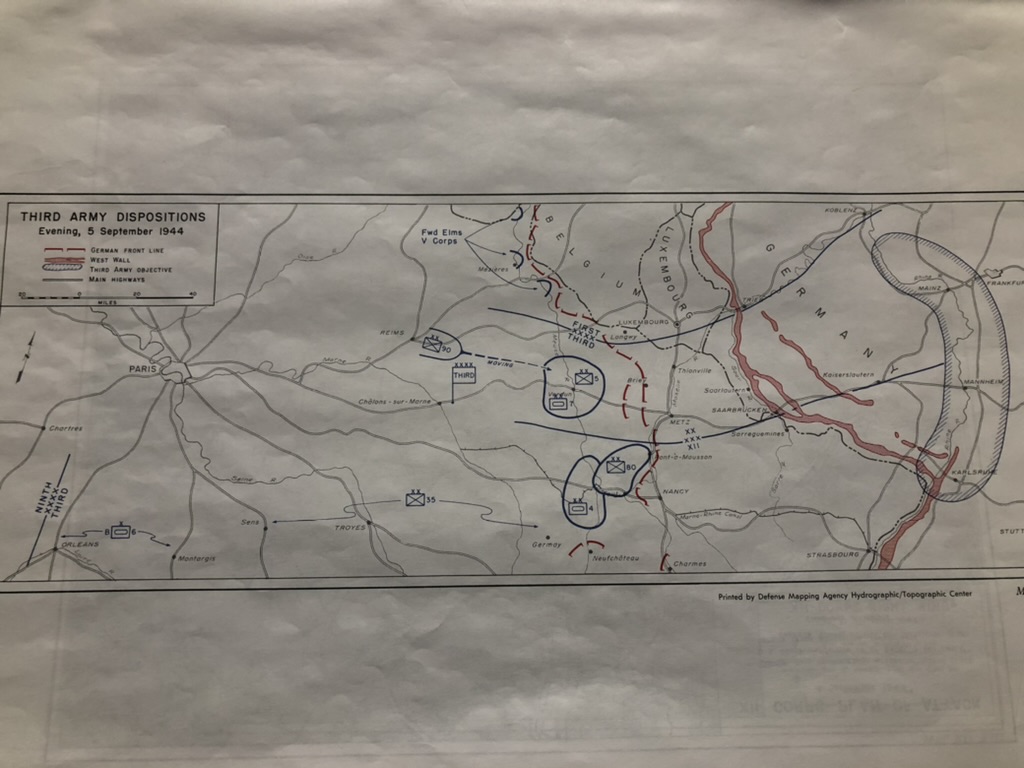
Below — Map VI from Cole’s “The Lorraine Campaign” showing the location of the divisions of Third Army at the start of the operation.
What’s Next
The case study will include books on the campaigns and their differing perspectives and assessments of the campaign; a list of the best maps for studying the battle and battlefield; a miniature wargame scenario or two; and suggestions on how best to visit the fascinating battlefield of Lorraine. I hope that you’ll join me in this study of one of my favorite campaigns in the ETO.